ACTUAL FOREX TRADING


The Complete Guide to Using Moving Averages in Forex Trading
Moving averages are the most popular technical analysis indicator.
They can signal market and trend direction, act as support and resistance, provide a trading edge, and more...
On this page, you will learn everything you need to know about using moving averages when trading the Forex market.
Jump to:

"Moving averages are by far the most useful indicator. Are they lagging? Yes. Do they provide false signals? Yes. Are they still worth using? Yes! Show me a price action pattern, candlestick setup or technical indicator that is 100% reliable. You can't, as it doesn't exist! The key is to combine moving averages with other forms of analysis. Layering price action and indicators is key!"
A Beginner's Guide to Moving Averages
In Forex technical analysis, you can use many indicators. The most common indicators include the Relative Strength Index (RSI), Volume, Bollinger Bands, and the MACD, to name a few. Moving averages, however, are the most famous indicators. Most traders use them - independent retail traders, professional traders, and market analysts.
What are moving averages?
As the name suggests, moving averages move. The moving average represents the market's closing price over a specified period.
For example, a moving average of fifty calculates the average closing price of the last fifty candles, and a moving average set at twenty-five calculates the average closing price of the last twenty-five candles.
You can use these averages in various ways, which I cover below, but they always serve the same purpose: forecasting direction.
What are the SMA and EMA moving averages?
The two most popular moving averages are the simple moving average (SMA) and the exponential moving average (EMA). The difference is that the EMA weights recent price data more than older data; the SMA does not. In other words, the SMA calculates averages, whereas the EMA calculates averages with more emphasis on recent closing prices.
Which is better, the SMA or EMA?
Like most indicators and forms of market analysis, it's a matter of personal preference. No single moving average type is better.
I personally use SMA's.
What do moving averages look like?
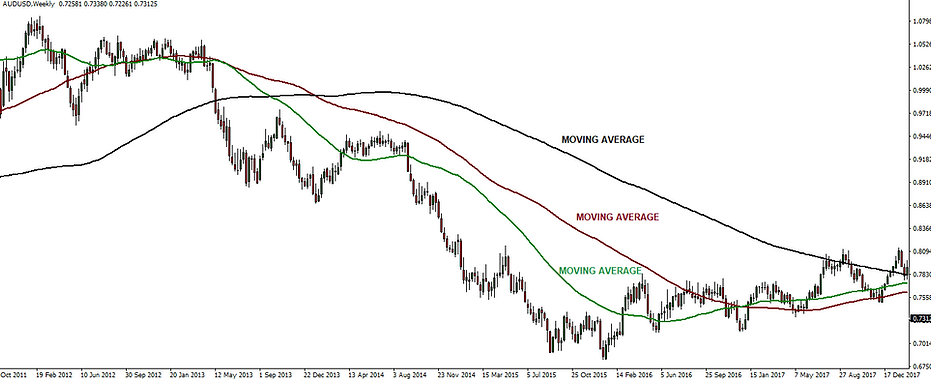
Averages are calculated, plotted on price charts, and joined to create a line or wave across a price chart. These waves are generally coloured and will look like this:
Moving Average Settings Explained
There are various moving averages, the most common types being SMAs and EMAs.
However, moving averages have only one variable, regardless of type: the moving average period, or length.
A moving average period is the number of candles the moving average uses for its closing-price calculations. A period of ten uses the closing price of the last ten candles, whereas a period of two hundred uses the closing price of the previous two hundred candles.
Fast and slow moving averages
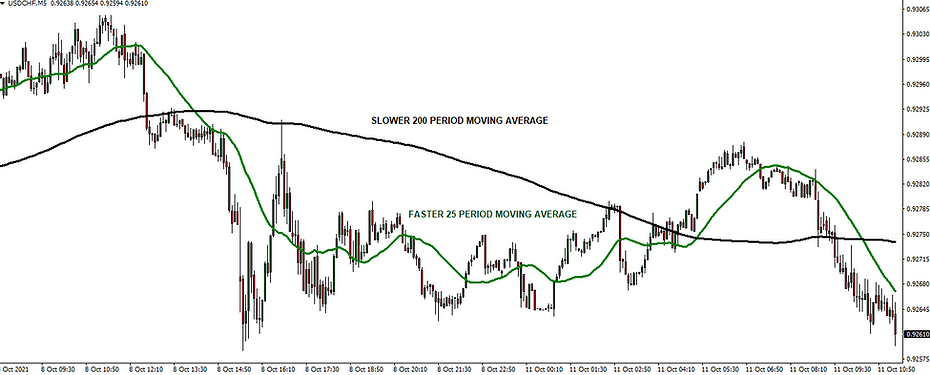
A shorter period makes a moving average "faster". It reacts quicker to recent price data and is generally closer to price. Faster moving averages can look jumpier.
A longer period makes a moving average "slower", meaning it reacts less quickly to recent price data and is generally further from price. Slower moving averages are generally smoother.
Below is a helpful example. The black moving average has a period of two hundred. The green moving average has a period of twenty-five.
What are the best Moving Average Settings?
This is a common question that many traders ask. The first thing to mention is that no moving average setting will provide a 100% reliable and accurate indicator - that's impossible. The second thing to say is that no single setting is suitable for everyone - the way you trade and analyse the market and the strategies you use impact the moving average period and type you choose.
However, below are my recommendations:
Moving Averages for Swing Trading
If you watch Bloomberg or have seen professionals trade, you may have noticed three moving average periods commonly used: the 50, 100 and 200-period moving averages. These are the settings I use, and I recommend you use them, too. I use these moving averages on the weekly, daily, four-hourly, and one-hourly time-frames.
I use these moving averages for the following reasons:
-
It makes logical sense to watch and use what the professionals are watching and using. You want to be trading like them.
-
They work. These periods are more reliable than most others, especially regarding dynamic support and resistance (more on that later).
Moving Averages for Day Trading
Regarding day trading, moving average periods used by traders vary greatly.
Some day traders still use the periods recommended above. They analyse higher time frames with the 50, 100, and 200 moving average periods and day trade based on that information.
Day traders focusing on low time frames, such as the 1-minute, 5-minute, and 15-minute charts, tend to use the 7, 14, and 21-period moving averages.
Using Moving Averages to Forecast Forex
As mentioned previously, moving averages are the most popular trading indicator. I love them. They provide an edge and can be used in many helpful ways, including chart analysis, market entry, and exit.
Below are details on the most common ways moving averages can be used:
Forecasting Market Direction
Moving averages can confirm downtrends, uptrends, and ranges.
The best way to use moving averages for market and trend direction is to have a faster and slower average on your price chart. I suggest combining the 50 SMA and 100 SMA or the 100 SMA and the 200 SMA.
When the slower-moving average is above the faster-moving average (i.e., the 100 above the 50), this can confirm a downtrend. These are called bearish moving averages.

When the faster-moving average is above the slower-moving average (i.e., the 50 above the 100), this can confirm an uptrend. These are called bullish moving averages.

When the moving averages cross frequently and move sideways, this can confirm market indecision or a market range:

You can also confirm trend and market direction by paying attention to the direction of a single moving average.
If a moving average moves steadily downward, price could be down-trending.
If it moves steadily upward, price may be trending up.
If a moving average moves sideways, it can signal market consolidation.
Forecasting a Change of Market Direction
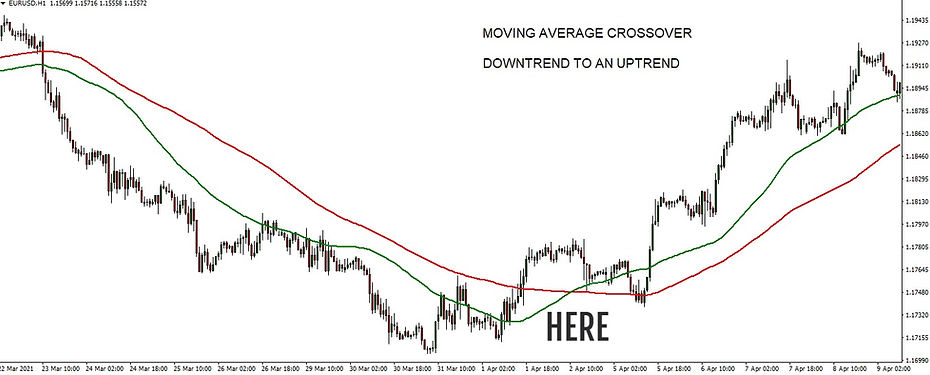
When two moving averages (a faster and a slower one) cross, this can signal a shift in market direction.
Some trading strategies are based on moving average crossovers.
When bullish moving averages cross and become bearish, this can signal a shift from an uptrend to a downtrend.

When bearish moving averages cross and become bullish, this may signal a shift from a downtrend to an uptrend.
"Trading moving average signals by themselves will not make you a successful trader. No profitable trading strategy is based just on a technical indicator. Moving averages (and all indicators) should be used for confirmation of market analysis or as part of a trading strategy, not the sole reason to enter a trade"

Moving Average as Support and Resistance (dynamic support and resistance)
This is my favourite way to use moving averages.
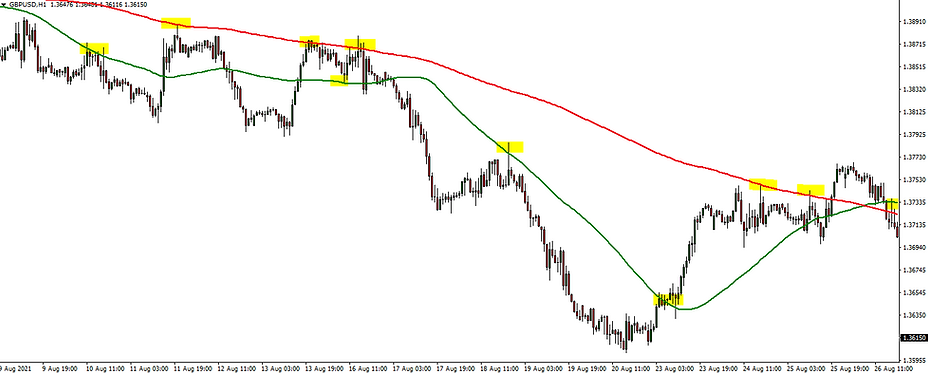
Moving averages provide support and resistance. This is called dynamic support and resistance.
You can use dynamic support and resistance for trade entry, exit, and market analysis. It can be a great addition to a Forex trading strategy.
The examples below illustrate moving averages acting as support and resistance. You'll see that when price reaches a moving average, it can reverse there, just as it can around horizontal or diagonal support and resistance.

Trading Strategies using Moving Averages
Moving averages can be a significant part of any trading strategy. My trading strategies use moving averages to confirm market direction and provide support and resistance for adjusting my stop-losses.
Trading strategies often use moving averages in the following ways:
-
The Moving Average Crossover, i.e., for trend reversals
-
The Moving Average Pullback, i.e., as dynamic support and resistance on trend retracements
-
Moving Average Direction, i.e., for identifying trends and market indecision
Moving averages can help with any of the following as part of a trading strategy:
-
Trade Direction
-
Trade Entry
-
Trade Exit
-
Take Profit Adjustment
-
Take Profit Placement
-
Stop-loss Adjustment
-
Stop-loss Placement